 English
 français
 italiano
 Español
 português
 العربية


Feb 15, 2024
Blog

For coffee producers planning a new production line or upgrading existing equipment, a structured capacity calculation helps determine whether a machine can meet current orders and future demand. This guide explains how to convert daily demand into capsules per minute, account for production losses, identify equipment bottlenecks, and prepare the information needed when requesting a machine quotation.
Coffee capsule filling machine capacity refers to the number of capsules a machine can process within a defined period. However, manufacturers should distinguish between rated speed, actual running speed, and saleable output because these measurements describe different aspects of production.
Rated machine speed is the nominal production rate specified for a particular machine configuration under defined operating conditions. It is commonly expressed in capsules per minute or capsules per hour.
Actual running speed measures how many capsules the machine produces while it is operating. It may be lower than the rated speed because of material feeding conditions, small stoppages, operator adjustments, or other process limitations.
Saleable output refers to the number of finished capsules that meet the required quality standards. It excludes rejected products, incomplete fills, sealing defects, and other nonconforming units.
| Capacity Measurement | Meaning | Purpose |
|---|---|---|
| Rated Speed | Specified machine production rate | Initial equipment comparison |
| Actual Running Speed | Units produced during operating time | Production performance monitoring |
| Gross Output | Total capsules produced before rejection | Production quantity tracking |
| Good Output | Capsules that pass quality inspection | Order fulfillment planning |
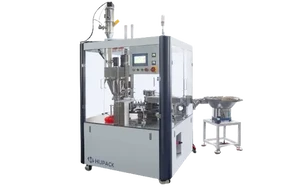
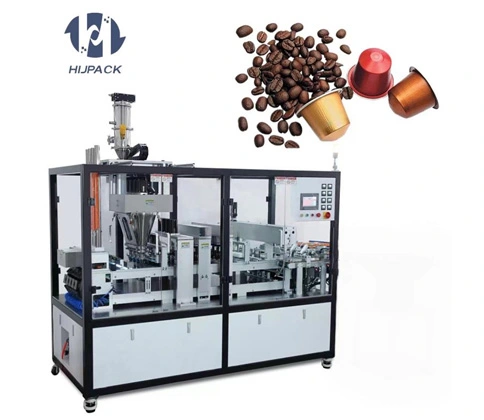
For example, the HIJPACK CF80 coffee capsule filling and sealing machine is listed with a productivity of 3,600 units per hour. This is equivalent to 60 units per minute. However, the published figure should be treated as a rated reference rather than a guaranteed quantity of saleable capsules per shift.
When comparing a coffee capsule powder filling machine, buyers should check whether the quoted capacity refers to filling alone or to the complete filling and sealing process. The number of filling heads, production lanes, capsule dimensions, dosing method, and sealing configuration can all influence the final output.
It is also important to use consistent units. To convert capsules per hour into capsules per minute, divide the hourly figure by 60. For example, 3,600 capsules per hour equals 60 capsules per minute. This simple conversion makes it easier to compare equipment specifications and calculate production requirements.
For a standardized approach to manufacturing performance indicators, manufacturers can refer to ISO 22400-1:2014, which provides an industry-neutral framework for defining and using manufacturing key performance indicators.
The first step in capacity planning is to calculate how many good capsules must be produced during the available production time. This gives manufacturers a demand-based production rate instead of relying on an arbitrary machine speed.
The basic formula is:
Required Good Output per Minute = Daily Capsule Demand ÷ Available Production Minutes per Day
For example, suppose a coffee manufacturer receives an order for 18,000 finished capsules per day and operates one eight-hour shift. The shift lasts 480 minutes, but 30 minutes are allocated to scheduled breaks.
The available production time is:
480 − 30 = 450 production minutes
The required good production rate is therefore:
18,000 ÷ 450 = 40 good capsules per minute
This means the production line must deliver an average of 40 acceptable capsules every minute during the scheduled production window. The corresponding takt time is 1.5 seconds per capsule.
However, the machine must normally operate faster than this demand-based rate because production losses reduce the number of finished capsules.
To account for these losses, manufacturers can use the following planning formula:
Required Rated Speed = Daily Good Output Target ÷ (Available Production Minutes × Availability × Performance × Quality)
Assume the following planning conditions:
Daily good capsule demand: 18,000 units
Available production time: 450 minutes
Expected availability: 85%
Expected operating performance: 90%
Expected quality rate: 98%
The required rated speed becomes:
18,000 ÷ (450 × 0.85 × 0.90 × 0.98) = 53.35 capsules per minute
Under these illustrative assumptions, a machine rated at 60 capsules per minute would provide sufficient theoretical capacity for the 18,000-capsule target. The actual result must still be confirmed through production trials using the intended capsule format, coffee powder, filling weight, and sealing materials.
For businesses producing K-Cup formats, the same calculation applies, but the intended cup dimensions, filling weight, and production configuration must be considered. When comparing k cup filling machines, buyers should evaluate the number of lanes, dosing system, sealing process, and tested output under their actual operating conditions.
The demand-based production rate is closely related to takt time. The Lean Enterprise Institute's explanation of takt time provides a useful reference for matching available production time with customer demand.
A machine may have sufficient rated speed on paper but still fail to meet the daily production target because of downtime, product changeovers, reduced operating speed, and rejected capsules.
These losses should be measured separately to understand their impact on production capacity.
1. Downtime and equipment availability
Downtime includes periods when the machine is scheduled to operate but cannot produce capsules. Common causes include mechanical failures, material shortages, cleaning, maintenance, and equipment adjustments.
Availability can be calculated as:
Availability = Actual Running Time ÷ Planned Production Time
2. Changeover time
Coffee manufacturers may switch between different capsule sizes, lid materials, coffee blends, or packaging formats. Each changeover can require tooling replacement, parameter adjustments, cleaning, and sample testing.
If changeovers take place during scheduled production time, their duration should be included in availability losses. Recording the start and finish time of each changeover helps manufacturers identify opportunities to improve production scheduling and reduce unnecessary interruptions.
The Lean Enterprise Institute's discussion of setup-time reduction explains why shorter changeovers can improve production flow and available manufacturing capacity.
3. Operating speed losses
Even when a machine is running, its actual speed may remain below the rated speed because of inconsistent powder feeding, minor jams, sensor interruptions, or operator adjustments.
Performance measures how closely the actual running speed approaches the ideal machine rate.
4. Rejected capsules
Not every capsule produced during a shift will meet quality requirements. Incorrect filling weights, damaged capsules, incomplete sealing, and other defects can reduce the number of saleable products.
Quality rate can be calculated as:
Quality Rate = Good Capsules ÷ Total Capsules Produced
The following example shows how these factors work together:
| Production Factor | Example Value | Calculation |
|---|---|---|
| Rated speed | 60 capsules/min | 3,600 capsules/hour |
| Planned production time | 450 min | 8-hour shift minus 30-minute break |
| Availability | 85% | 450 × 85% = 382.5 running minutes |
| Performance | 90% | 60 × 90% = 54 capsules/min |
| Gross output | 20,655 | 382.5 × 54 |
| Quality rate | 98% | 20,655 × 98% |
| Good output | 20,242 | After quality losses |
This calculation demonstrates why rated speed and saleable output should never be treated as the same measurement. The example uses planning assumptions rather than guaranteed equipment performance. Actual values should be established from production records and machine trials.
Manufacturers can also use the Overall Equipment Effectiveness (OEE) calculation framework to monitor availability, performance, and quality together. These three factors provide a structured way to identify production losses without counting the same loss twice.
A complete coffee capsule packaging line normally includes several connected processes, such as empty-capsule feeding, powder dosing, sealing, finished-product discharge, and carton packaging. The overall output depends on how well these processes work together.
The slowest stage can become the production bottleneck. Increasing the speed of the filling machine alone will not improve finished output if the sealing or cartoning equipment cannot handle the additional volume.
To compare different stages, convert their production rates into the same unit, preferably capsules per minute.
For example, a filling and sealing machine may process 60 capsules per minute. A cartoning machine, however, is usually specified in cartons per minute. If each carton contains 10 capsules, the required cartoning speed is:
60 capsules/min ÷ 10 capsules/carton = 6 cartons per minute
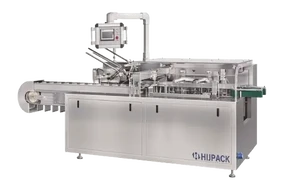
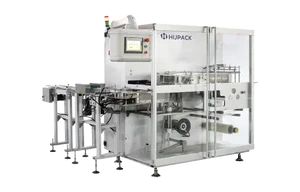
HIJPACK's WZTS-130 horizontal cartoning machine is listed with a production speed of 5–30 cartons per minute. Under the illustrative assumption of 10 capsules per carton, this corresponds to a theoretical range of 50–300 capsules per minute. Actual suitability must be verified using the intended carton design, capsule arrangement, feeding method, and operating speed.
The basic line-capacity calculation is:
Overall Line Capacity = The Lowest Effective Capacity Among All Connected Production Stages
For example, if filling and sealing can produce 60 capsules per minute but the downstream cartoning process can only package the equivalent of 50 capsules per minute, the effective line output cannot sustainably exceed the cartoning capacity without additional accumulation, buffering, or a change in packaging configuration.
This is why selecting an automatic cartoning machine should involve more than comparing cartons per minute. Manufacturers should also consider the number of capsules per carton, carton dimensions, feeding stability, product arrangement, and synchronization with upstream equipment.
The packaging industry also emphasizes equipment integration and downtime monitoring. PMMI's 2026 Overall Equipment Effectiveness survey highlights downtime, output, performance, and line-level integration as important areas for packaging machinery performance management.
Once the required production capacity has been calculated, manufacturers should prepare detailed technical and operational information before contacting an equipment supplier. This helps the supplier recommend a suitable machine configuration instead of relying only on a general production target.
The following information is particularly useful:
Capsule specifications: Provide capsule diameter, height, shape, material, rim dimensions, and technical drawings.
Filling requirements: Specify coffee type, grind characteristics, filling weight, and acceptable dosing tolerance.
Packaging materials: Provide lid material, sealing film specifications, and any additional packaging requirements.
Daily production demand: State the required number of finished capsules per shift, day, or week.
Working schedule: Explain the number of shifts, available production minutes, breaks, cleaning periods, and planned maintenance.
Product changeovers: Identify how many capsule formats or coffee varieties need to be processed and how frequently they change.
Quality requirements: Define acceptable filling weight variation, sealing standards, and the required rejection rate.
Downstream packaging: Specify the number of capsules per carton and whether automatic cartoning or additional packaging equipment is required.
Future expansion: Explain expected order growth and whether the production line may need additional lanes or automation.
For example, a buyer considering a coffee pod filling and sealing machine should provide actual capsule samples and confirm the required filling and sealing configuration. A two-lane design may support higher production throughput, but the final capacity still depends on the cycle time, material handling, and performance of the complete process.
It is also advisable to request a sample production trial before finalizing an equipment purchase. The trial should record actual production speed, filling accuracy, sealing quality, rejected capsules, changeover requirements, and continuous running performance.
A written acceptance plan should define the tested product format, operating conditions, measurement method, and required good output. This gives both the manufacturer and equipment supplier a common basis for evaluating whether the proposed machine meets the production target.
No. Rated machine speed represents the specified production rate under defined conditions. Saleable output is the number of finished capsules that pass quality inspection after accounting for downtime, speed losses, and rejected products. Manufacturers should use good output when calculating their ability to fulfill customer orders.
Calculate available production time separately for each shift, then account for the operating speed and changeover requirements of each capsule format. Different capsule sizes, filling weights, and sealing materials may produce different operating rates. For mixed production, calculate each format using its own validated data rather than simply averaging the rated speeds of different machine configurations.
There is no universal extra-capacity percentage that works for every manufacturer. The appropriate reserve depends on actual downtime, quality performance, order fluctuations, changeover frequency, and expected business growth. A better approach is to calculate current requirements using measured production data and then evaluate additional capacity against realistic future demand scenarios.
Calculating coffee capsule filling machine capacity requires a complete understanding of customer demand, scheduled production time, equipment performance, and product quality. Rated machine speed is only the starting point. Downtime, changeovers, speed losses, rejected capsules, and downstream packaging limitations all influence the final number of saleable products.
Before selecting a machine, manufacturers should:
Calculate daily good capsule demand and available production time.
Convert hourly and minute-based production rates into consistent units.
Account for availability, performance, and quality losses.
Compare filling, sealing, and cartoning capacities to identify bottlenecks.
Validate the proposed configuration using actual capsule samples and production trials.
The most suitable coffee capsule packaging solution is not necessarily the machine with the highest advertised speed. It is the configuration that can consistently deliver the required number of quality-approved capsules within the manufacturer's production schedule.
By using realistic production data and evaluating the complete packaging process, coffee manufacturers can make more informed equipment investments, reduce production bottlenecks, and build a production line that supports both current orders and future growth.